For Surgeons
Documentation Done. For You. Before You Scrub Out.
You finish a complex case. Your patient is in recovery. You should be preparing for your next case, talking to a family, grabbing lunch. Instead, if you haven't outsourced to a resident, you're sitting at a screen, reconstructing from memory what you just did with your hands - dictating a report that will never fully capture what actually happened in that OR.
That's over.
See Surgery-to-Text® in ActionBefore: The Way It's Always Been

After: Surgery with Theator
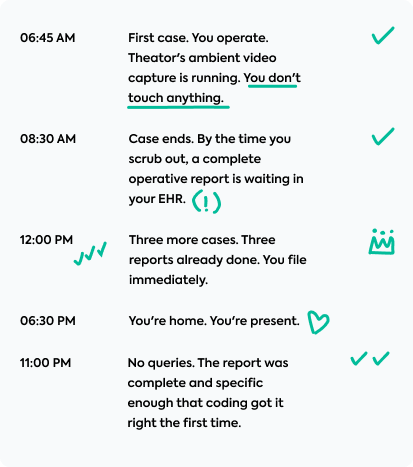
Surgery-to-Text® Analyzes and Understands Your Specific Surgery.
Through your existing laparoscopic or robotic camera, Theator's AI identifies every step, instrument, safety milestone, best practice, and event in real time. When the procedure ends, it generates a structured, billing-ready operative report draft and delivers it directly into your EHR.
You can modify, but probably won't want to.
No dictation. No cookie-cutter templates. No voice recording. Just the video, turned into the documentation you've always hated doing.

Why Video, Not Voice?
You know why. In minimally invasive surgery, your hands are busy and you don't narrate. Ambient speech tools capture what was said. That's less relevant in the OR. Surgery-to-Text® captures what was done. The ground truth is visual-and that's what Theator reads.
Every report reflects the actual procedure as performed: unexpected events, variations in technique, real complexity. Not a template. Not an approximation. Your patient and their unique surgery.
Available across 9 specialties and 180+ procedure types-from robotic prostatectomy to laparoscopic cholecystectomy to sleeve gastrectomy. If you perform minimally invasive surgery, there's a good chance we already support your cases. And we're continuously expanding.

The Numbers (for the Skeptics)
We get it - surgeons are scientists. Here's the data. Peer-reviewed at Mayo Clinic. Published in JACS, Nature, and Surgical Endoscopy. A deployed, validated platform.
Documentation Time

Surgical residents spend at least 30% of their time on EHR tasks, with interns spending a third of their EHR time outside scheduled shifts23. Users report ~70% reduction in documentation time with Surgery-to-Text®. Reports generated in <30 seconds vs. 15–30 min manually.
UHealth Miami2,3
Report Accuracy
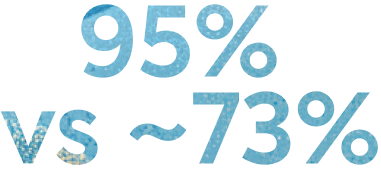
87.3% accuracy validated at Mayo Clinic vs. ~73% for human-generated reports. Current platform accuracy exceeds 95%.
Khanna et al., JACS 20251
Workflow Impact

Zero workflow change. No new devices. No dictation. Available in Epic and Oracle Health as soon as the surgeon scrubs out.
UHealth Miami deployment data
The stakes are higher than ever. Poor surgical resident wellness is associated with a 53% increase in the odds of reporting a major medical error20. Documentation burden is a leading contributor to burnout, and burnout costs the U.S. healthcare system an estimated $4.6 billion annually in turnover and lost productivity21.
Surgery-to-Text® Is Just a Start. Here's Where the Platform Takes You.
Quality Intelligence
You Can't Improve What You Don't Measure. Now You Can Measure It.
Theator provides surgeon, department, and system-level quality analytics grounded in what actually happened during the procedure, not indirect proxy measures.
Variability Reduction
30–50% reduction in procedural variability across participating sites.
Source: Theator multi-site deployment data
Benchmarking
Compare and evaluate technique, timing, and outcomes across surgeons, sites, and specialties.
Outcome Correlation
Link intraoperative decisions to post-operative outcomes using video ground truth.
Your Real-World Evidence, as Data.
Theator enables multi-site, IRB-approved research using structured surgical data at a scale never before possible. Published in JACS, BJUI, Nature, Surgical Endoscopy, and dozens of peer-reviewed journals.
Peer-Reviewed Evidence
Featured Publications
J Am Coll Surg 2025
Khanna et al.1
AI-generated operative reports exceed surgeon-authored reports in accuracy
Mayo Clinic, n=158 robotic prostatectomy cases.
BJUI COMPASS 2024
Khandekar et al.3
AI-measured warm ischemia time within 8 sec of ground truth vs. 2.45 min for operative reports
University of Miami, n=61.
Art Int Surg 2025
Messer et al.7
AI reveals variability across 4 centers
Assuta Medical Centers, n=10.7K procedures.
J Endourol 2025
Henning et al.12
Mayo Clinic Film Room — largest published study of urology trainee video review
13 trainees, 480 learning points. 94% reported video review helped develop surgical skills.
Ann Surg 2024
Fried et al.6
Surgical intelligence drove critical view of safety adoption from 33% to 76%
279 procedures, 46 surgeons. Cases with CVS were 13 min shorter with fewer adverse events. First real-world use of AI to modify surgeon behavior for best-practice adoption.
AUA 2025
Khandekar et al.4
LLM + surgical intelligence found 20.2% of surgical events missing from operative reports
180 urologic procedures, 2,909 events. 95.8% AI accuracy in auditing reports against video ground truth. University of Miami.
Stop Typing. Start Living.
You chose surgery because you wanted to save lives, not fill out forms.
See what your day looks like with Theator.
Frequently Asked Questions

1Khanna A, Wolf T, Frank I, et al. Enhancing accuracy of operative reports with automated artificial intelligence analysis of surgical video. J Am Coll Surg. 2025;240(5):739-746.
2University of Miami Department of Urology: Epic-integrated Surgery-to-Text® pilot demonstrating 70% reduction in time to final op note, median 6 edits per case.
3Khandekar A, Porto JG, Daher JC, et al. Accuracy of warm ischemia time measurement using a surgical intelligence software in partial nephrectomies: A validation study. BJUI Compass. 2024;5(12):1263-1268.
4Khandekar A, Shah H, Freitas P et al. Surgical intelligence and large language models: leveraging AI for complete and accurate operative reporting. American Urological Association (AUA) Annual Meeting 2025.
6Fried GM, Ortenzi M, Dayan D, et al. Surgical intelligence can lead to higher adoption of best practices in minimally invasive surgery. Ann Surg. 2024;280(3):525-534.
7Messer N, Nizri E, Lahat G, Szold A. Implementing an AI-powered endoscopic surgery video recording system in a large hospital network: lessons learned and future prospects. Artificial Intelligence Surgery. 2025;5(2):182-190.
11Henning GM, Findlay BL, Cohen TD, et al. The film room: using artificial intelligence to facilitate video review for urology trainees. J Surg Educ. 2024;81(11):1743-1747.
12Henning GM, Findlay BL, Cohen T, et al. A step toward modernization of urologic training: incorporation of a novel surgical intelligence platform for robotic prostatectomy video review. J Endourol. 2025;39(11):1204-1210.
20Hewitt DB, Ellis RJ, Chung JW, et al. Association of surgical resident wellness with medical errors and patient outcomes. Ann Surg. 2021;274(2):396-402.
21Han S, Shanafelt TD, Sinsky CA, et al. Estimating the attributable cost of physician burnout in the United States. Ann Intern Med. 2019;170(11):784-790.
23Cox ML, Farjat AE, Risoli TJ, et al. Documenting or operating: where is time spent in general surgery residency?. J Surg Educ. 2018;75(6):e97-e106.